Journal Pro

Post

Monday, December 18, 2006

scratch pad

gorilla video
http://viscog.beckman.uiuc.edu/grafs/demos/15.html

Informal Learning Book

Nathan Tyler
650.253.4311
nate@google.com

Saturday, December 17, 2005

Old Report Cards

I dug up copies of my report cards from those years. here are the teacher comments in their entirety:

first grade, 1950-51.

1. first quarter. james has all the potentialities of a good pupil. however, he must try to be a little neater in his written work. james must also learn to show more respect for his fellow pupils and his teacher. he must practice self-control. james has completed three pre-primers and is now in a primer. his number recognition is excellent. his letter formation is poor.

2. second quarter. james has made a fine improvement in his letter and number formation. his art work is still careless and untidy. james has completed ten pre-primers and is now reading in a primer. he has slipped behind in his reading and we hope that he will strive to be more attentive during his reading period. james has not yet learned the meaning of self-control. for his own benefit and the benefit of his classmates, he must put forth every effort to master it. james must also learn to be prompt after his recess period.

3. third quarter. the additional guidance in reading that james has received is evidenced daily. it is gratifying to see his new attitude for I realized he was letting his ability lie dormant. james has matured a great deal and is a very cooperative member of our class now.

4. fourth quarter. james is reading with the first reading groups. his word recognition has improved. he must work on oral reading -- for he is rather slow in it. james does very well with number combinations and is quite able to apply his learning to everyday situations. I hope james will keep up the good attitude towards school he has developed this year.

second grade.

1. first quarter. james is capable but does not begin to work comparable to his ability. he does almost no independent reading and when he is pushed into his written assignments, they are often very carelessly done. consequently he has much time for mischief and spends his time being most disturbing to his class and his teacher. although there has been noted some improvement during the past weeks of school, there is much to be desired in his behavior. I feel he has learned very little since entering this grade as compared with the rest of the group. until he learns obedience, cooperation, and assumes an attitude of responsibility toward his work and his class, there cannot be the proper growth on his part, and he will not become the fine pupil I feel he is capable of being.

2. second quarter. James has shown much growth during the past quarter. he is beginning to feel some responsibility toward his work and the group; his attitude is less that of trying to get attention through misbehaving than that of receiving legitimate recognition through cooperation and for a job well done. however, he continues to show little interest in reading in school; it is only after much prodding that he will settle down even to his required reading. instead he has something to play with in his hands constantly. his written work is being very well done, for which he has been praised quite frequently. with continued interest, effort and cooperation, I feel james is well on hie road toward becoming a responsible and contributing member of our group. I appreciate your cooperation at home.

3. third quarter. james has become much more cooperative in the classroom. he concentrates on his written work; and though recently he has become careless in writing, he does his job quickly and well, seeming to enjoy it. he seems interested in our class discussions, and during our sharing period, has made many interesting contributions. he is very good in his number work. I believe this reading interest is beyond his reading ability. as a result we can find no reading material at school that he will try to read. he does not feel a responsibility for doing much that he does not want to do. he needs to mature and to grow in emotional control before he can become a well-adjusted member of the group.

4. fourth quarter. james' work continues about the same. he seems to enjoy his written assignments but he still tries to see how fast he can complete them with the result that his writing greatly suffers. his spelling and phonics are quite good and he continues to enjoy his number work. a few times he has attempted reading without pressure, nearly always from a book too difficult for him. this I know is discouraging for him and he rarely ever completes a story. I hope as he matures he will realize he must read on his own level until he masters the mechanics of reading. he is becoming somewhat more cooperative in the classroom and shows more self-control.

third grade.

1. james has shown a great deal of growth in self-control during this quarter. he has a searching mind that will take him far as he learns to apply it to the matters at hand. his work has improved in neatness, though he still has a tendency to do his assignments hurriedly. this is especially evident in his art and craft activities. james has made an excellent room president and is beginning to understand, I think, that he can win the respect and admiration of his classmates with his qualities of leadership and good mind more easily than thru misbehavior.

2. second quarter. I shall be sorry to see james leave. he has displayed a great deal of imagination and effort this quarter. he learns quickly and always has many worthwhile things to contribute to the group. when his interest is captured, he Is an enthusiastic and painstaking worker. his weakness lies in language. the grammatical structure of his sentences is frequently very poor. his spelling and arithmetic, however, have reached an A level, and he reading (sic) with more expression and pleasure. james has been a challenging pupil. if he continues putting forth the effort he has shown his quarter, I'm sure he will become an excellent student.


Saturday, November 12, 2005

tickle


Tuesday, August 16, 2005

Word for Blogger

So, this is my first posting using Blogger for Word, an add-in that was released today. I installed it, opened Word, and found a new toolbar. Then I clicked Blogger Settings to give it my login and password. Finally I clicked “Open Post” and I’m tapping a Blog entry into Word.  

(In the process, I find that Word’s standard dictionary contains neither Blogger nor Blog in its vocabulary.)

One major limitation is that graphics don’t transfer. In a minute, I’ll see if I can add them after the fact.

Let’s close with some type in RED.  And some yellow highlighter.

  • Arial.

  • Verdana.

  • Trebuchet.

  • Comic Sans MS

  • Bookman Old Style.

Sunday, August 14, 2005

New Blogger format

I need a new blog format.

Sophisticated look.
Tagging via Technorati or some other categorization method

informal learning...

Saturday, July 30, 2005

Il giornale

The disk read yesterday has freaked me out about keeping information on this machine. It's probably time to replace it with something reliable...and quiet.

Sunday, July 24, 2005

"The Talmud says, If I am not for myself, who will be? If I am only for myself, who am I? If not now, when?"

this might be worth checking out http://www.wikispaces.org/

Hawking

Sunday. On Thursday, I was on the operating table for three hours undergoing a cardial ablation. That's not what I'm thinking about. Part of the ablation involved boring a hole in a large vein in my groin. I spent Thursday night in the hospital keeping my leg still to help the wound heal itself. Friday evening the bandage began to come unattached. I began to bleed. By morning my underwear looked as it would had someone shot me in the thigh: the righthard side was soaked with blood. Saturday I applied a succession of bandages...and continued to bleed. In the evening I talked with the on-call cardiologist who told me to cut the anticoagulant drugs and apply pressure. This worked until I fell asleep and disturbed the wound; I awoke among bloodstains but soon had things back under control.

Today I am confined to bed. Leg is straight and immobile. Uta brings me food. I flashed on Stephen Hawking. Of course I've got a ways to go before I reach his state.

Pieces of the book are starting to fall into place. The ecosystem/bio/complexity metaphor holds up as an alternative model for learning. Adaptation to a rapidly changing, unpredictable world is the WIIFM of both business and individuals. Fit is the metric. Can we breed -- in this case, produce?

The flow is:

  1. here's what going on in your ecosystem(s)
  2. here are the consequences to your fitness
  3. figure out your WIFFM
  4. hints on what it takes to live a full life (stories)
  5. models to follow...

Monday, July 04, 2005

Thinking Out Loud

Learning is like time or matter or space -- too big to get one's arms around. Every capability that's not genetic has been learned, intentionally or not.

Informal Learning focuses on work-related learning. That includes improving the work and the worker, so personal stuff is in the zone.

Stories are king. Narrratives work. Should I be telling my own story and if so, how much?

I love exploring more than mapping the territory I've explored. Now feels like the time to return to camp and document some of my travels.

Friday, April 29, 2005

article start

Certainly, the numbers heading for Golden Pond are staggering. Today, about 1 in 8 Americans is 65 years or older, compared with 1 in 25 at the turn of the century. By 2030, 1 in 5 Americans will be elderly. And senior citizens are around for a lot longer. Life expectancy at birth was 47 years in 1900; in 1993, it reached 76 years. For those reaching age 65, average life expectancy for men is projected to rise from a current 81 years to 85 in 2040; for women, it's 85 and 88. The fastest-growing segment of the population is the so-called oldest old--those 85 years or more.

Workplace changes are part of the demographic transformation, too. People will be working longer, and older people will contribute more to economic growth. Clearly, the information economy will ease the transition to longer working lives. Working with computers in service-sector occupations such as financial services and medical diagnostics is much less demanding physically than manning an auto assembly line or mining for coal. Says Maria C. Robotham, manager of health care and aging studies at the Futures Group Inc., a consulting firm: "We are also finding more interest in second and third careers. A lot of retired people are returning to start a new career."

Saturday, April 16, 2005

Instructional Design

IEEE, 2002
http://www.ieee.org/organizations/eab/tutorials/refguide/mms01.htm

Instructional design is the process through which an educator determines the best teaching methods for specific learners in a specific context, attempting to obtain a specific goal. This reference guide is designed to help you apply sound principles of design to the creation of your courses. The overview presented here is based on the model developed by Walter Dick and Lou Carey, which provides a systematic, step-by-step approach to designing (and then improving) effective and objectives-based instruction. Keep in mind that the content is presented here in a linear manner, but there will always be movement between and among phases. Also, remember that not all of these phases may apply to your situation. Depending on your needs, you may work through this reference guide in a linear manner, using the Back and Next buttons on the left side of the screen, or you can click the phase and section that apply only to your current interests and requirements.

In other words, the student doesn't find a path to knowledge; he does what the instructor pushes out.

Wednesday, April 13, 2005

industry HR/strategic needs

banking
get new products to market quicker and with less money, while supporting and extending customers' relationships with the bank.

shift some customer transactions away from branch offices and help reduce costs by eliminating the need to hire additional call center agents.

long cycle times for procurement processes at Credit Suisse needed improvement, but it needed an approach that would help reduce overall sourcing costs, improve responsiveness and accommodate fluctuations in demand.

increase its responsiveness and improve customer satisfaction, Charles Schwab was looking for a way to enable its client representatives to provide immediate, realtime advice to customers, within an existing IT infrastructure.

While Travelex’s systems had largely kept pace with business requirements, they had grown in a reactive, incremental manner. This, coupled with a large number of acquisitions, led to a disparate array of systems that were complex and expensive to maintain. Complexity also undermined Travelex’s ability to develop new services rapidly and efficiently—a “must-have” to sustain its intense level of innovation. The lack of a flexible, standard means of integrating with commercial customers presented a two-pronged threat. First, as the sheer number of proprietary connections grew, performance went down and cycle times went up, which delayed the processing of customer transactions. Second, non-standard integration made it harder for new SMB customers—many of whom had few, if any, in-house IT staff—to establish the necessary connections.

Based on a comprehensive evaluation, the firm mapped out a five-year transformational plan that will convert its business into a component-based business model, make it more agile and responsive to its customers -- a

services-oriented architecture, based on open standards, to support enhanced communications and integration, and virtualization, to make better use of existing assets. Ultimately, the goal is to create a more efficient, available and resilient architecture and set of tools that will permit Schwab to deliver relevant, consistent advice in a more responsive manner--whether the customer is at an investment center, on the phone or on the Web.

an application to support internal auditing work because of modified regulatory requirements.


INSURANCE
Until recently, insurance customers did not have the convenience of a Web self-service portal designed to meet their needs. Each insurance line of business (LOB) presented policyholders with its own Web site, and account access was not consolidated. “Without a common look-and-feel or any personalization capabilities, there was ample scope for us to be more proactive in the way we serviced our clients,” explains David Kennington, vice president of Information Systems at Prudential. “Plus, growing profits in a mature business such as insurance requires reducing costs. Moving more services online is a way to reduce customer service representative involvement in the processing of routine requests.”

Take the leadership position in the marketplace by strengthening customer service, accelerating service delivery and streamlining operational processes

“ICA members needed to adapt to rapidly changing regulatory requirements, yet remain focused on their budgets and the competition”

Improve decision making and lower IT costs by streamlining multiplatform information management infrastructure

Thursday, April 07, 2005

ed & med from petere kaminski

On 4/6/05 12:24 PM, "Peter Kaminski" wrote:

It's not so much that corporations control education or medicine.

American education and American medicine were systemized at the same time,
and very purposefully, by the same people, as industrial capitalism was.
Certain sets of principles and beliefs were chosen to codify and expand, and
any competing systems were deliberately wiped out.

American education and American medicine aren't controlled by industrial
capitalism, they are industrial capitalism. Industrial capitalism controlled
the way these public issues were systemized, setting up the ground rules,
creating the playing field, and deciding how we keep score. We keep score in
two ways: public good (as measured by folks hired by capitalists) and
profit, how much money the capitalists make.

I don't say this as a value judgement, just as a statement of historical
fact. If we understand better how we got here, maybe we can influence the
future more effectively to make things better for everyone.

There is a lot of good that comes from the industrial heritage, along with
some bad things.

Good things:

* systemized and standardized
* universally available (to more or less practical limits)
* proven effective by measurement and goal-oriented improvement

Bad things:

* reductionist instead of holistic
* mechanist instead of humanist
* monoculture - measurement is good for averages, but not individuals
or outlying groups
* goal-orientation is sensitive to who chooses the goals

So, I see good news from this look back. The systems we've got now are huge
and deeply integrated into our system of capitalism, but, they were not
instituted thousands of years ago and baked into our DNA. They're not
immutable natural laws. They were catalyzed only a hundred years ago, by a
few people spending lots of John D. Rockefeller et al.'s money.

Those folks had a lot of leverage then because they were on the cusp of a
system change into industrial capitalism, but I think we're in the middle of
the same sort of sea change as the world saw with the Industrial Revolution.
If you know your purpose, it's a good time to act.

Additional reading material:
The Underground History of American Education

, by John Taylor Gatto Also
see the history tour

on the same site.
Rockefeller Medicine Men: Medicine and Capitalism in America, by E. Richard
Brown Rockefeller Medicine Men at Amazon


Full text of Rockefeller Medicine Men at the Soil And Health Library


Scanned images of Rockefeller Medicine Men at Dr. Rath Health Foundation


Mr. Gates's Summer Vacation

, by Charles S. Bryan, MD
Focuses on Frederick T.Gates role in creating American medicine, check out
the chart labelled "Gates's 10 Basal Facts about Medicine" The Drug Story

, by
Hans Ruesch About the Rockefeller drug empire. I can't vouch for this
publisher, but the story is worth checking out. --
Pete
http://peterkaminski.com/archives/000444.html

Thursday, March 31, 2005

Kaplan vs McCarthy

What Are the Measures That Matter? By Art Kleiner

http://www.well.com/user/art/s%2Bb12002.html

Tuesday, March 29, 2005

No boss, no center

each of us is alone in the universe
so is everyone else

e. e. cummings
The meme I'm exploring today is that there is no center. No ultimate authority. No boss. No hierarchy. We have workarounds to deal with the fiction that these things exist.

Scientists since Copernicus have assured us that the Earth travels around the Sun, but from my perspective, the Sun appears to travel around me. In fact, the entire universe feels as if it revolves around me. I'm at the center, looking out.


If everyone feels this way, there's a problem. We isolate ourselves. If I'm defining my own reality, who the hell are you to butt in?

collision

Better that we realize that we're all in this together.

revolver

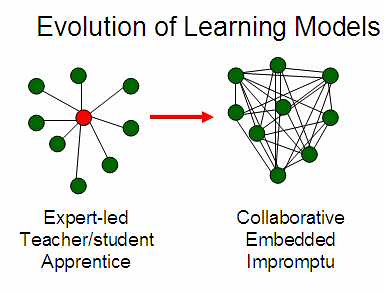
This translates down to this. The black box is simply a router, a facilitator of direct connections.

router


evolution of networks

learning models

Sunday, March 27, 2005

SOA Governance Notes

“Business and IT value chains today have started to merge together in the industry. We now speak of enterprise architecture and Service-Oriented Architecture (SOA) that are independent from IT implementation. With this change, we also need to adapt the way we structure businesses and IT landscape, define and develop architectures like SOA, and run enterprise-focused client engagements.

For all these reasons, governance plays a more important role in today's IT than it ever has before. In this article, I share IBM IT Management Consulting (ITMC) team's best practice governance approach, which we developed and implemented in several client engagements. Starting from proven IT governance structures and practices, I enhanced our governance model to meet SOA requirements.

Today, IT must react very quickly and flexibly to enable business almost in real time. IT has to design and manage part of a highly integrated and complex enterprise architecture, with increasingly blurred boundaries between business and IT components. This article proposes key governance functions that will help you achieve these goals and implement successful SOA engagements.

* IT's alignment with the enterprise results in the promised benefits being realized.
* IT enables the enterprise so that opportunities are exploited and benefits are maximized.
* IT resources are used responsibly.
* IT-related risks are managed appropriately.

Our governance model illustrated in Figure 1 is a com

Much more available in this paper

IT Governance Institute: briefing http://www.itgi.org/Template_ITGI.cfm?Section=ITGI&CONTENTID=6658&TEMPLATE=/ContentManagement/ContentDisplay.cfm

Microsoft on SOA Governance

Service Governance

Challenge

Regardless of the way service domains are defined within an enterprise, there are various philosophical and technical approaches for creating new services and modifying existing services. Who should monitor, define and authorize the changes to the existing suite of services supported within an enterprise? Who should own the provisioning and maintenance of these services?

Approaches

An enterprise can address the challenge most effectively by establishing an internal governing body. Multiple governance models are possible. These are discussed below.

Central governance

With central governance, the governing body within the enterprise has representation from each service domain as well as from independent parties that don't have direct responsibility for any of the service domains. There must also be representation from the different business units and from subject matter experts who can speak to the key technological components of the solution. The central governing body as a whole reviews addition and deletion of services, as well as changes to existing services, before authorizing their implementation.

Click here for larger image.

Figure 10. Central governance model

As shown Figure 10 above, the central governing body is responsible for establishing and enforcing service-oriented architectural guidelines and standards across the enterprise. The body is also responsible for communicating those standards to the business units, architectural teams and technology teams.

Distributed governance

With distributed governance, each business unit has autonomous control over how it provides the services within its own organization. Distributed governance mandates a functional service domain approach. A service architecture committee can still provide high-level guidelines and standards for implementation of services, but that committee doesn't have to authorize changes to the existing service infrastructure within a business unit. The committee suggests compliance with these guidelines but does not enforce it.

Click here for larger image.

Figure 11. Distributed governance model

In the distributed governance model shown in Figure 11, business units A and B have the freedom to establish their own independent standards. Yet appropriate passive measures (architectural and procedural guidelines) are in place for the units to follow.

Thursday, March 24, 2005

gloria references

Gloria Gery blows my mind. She looks for all the world like an old-time schoolmarm and yet year after year, she comes up with an inspiring message.
This morning she said “We’ve engineered the supply chain to the fourth decimal. We’ve done the same in re-engineering our processes and customer relationships. Human Capital Management comes next.”

Gloria says that we can’t define eLearning as installing an LMS. We’re not about KM or documents or technology – What’s important is the performer, to be able to name that tune in one note, to perform in exemplary fashion. We have to understand the work that people do. Most of all we have to be able to sit in the learner’s chair, to find out how the work comes at them. For the call center, we shouldn’t model how things should go theoretically. (Gloria’s visited many a call center – and they are reminiscent of a Charlie Chaplin movie’s factory frenzy.) This feel for the context enables us to shift the responsibility for success to the situation.

On a recent visit, Gloria found call center reps who had to deal with a dozen software apps acquired from mergers, a nearly impossible task. They had to construct mental maps of complex processes just to function. We need to put the real truth into our training. We need to understand what really goes on. Courses are necessary but not sufficient. We must have a strategy. Architecture is a part of it. Courses are a part of it. But we must understand people, how they learn, how they collaborate, how inquiry teaches, how we learn from observing models, incremental development of understanding.

“I was born when White Out was a technological innovation. I remember when I first saw word-wrap; everybody came over to take a look. How young are you?” asked Gloria.

In addition to eLearning, think as well of automating the task, teaching, providing content, supporting processes, supporting collaboration.

Why should we have to live with error messages like “File sharing illegal error?” Look at the evolution TurboTax. Simplify, simplify. `

Repetition is the mother of impression.

What are the best strategy and tactics to accelerate performance improvement? Our job is to develop computer-mediated environments that fuse, integrate…

You need to look at examples – they’re on the web. You purpose is to enable performance, not to implement eLearning. If not us, who? We must partner with our business clients and make life better for people who are skilled.Posted by Jay Cross at September 23, 2002 11:45 PM


Gloria Gery named Workflow Institute Fellow
Sam and I are delighted to announce that Gloria Gery has accepted our invitation to become the first Fellow of the Workflow Institute.

Gloria invented the field of Electronic Performance Support. She was a champion of performance-centered design twenty years before its current popularity. She has taught our industry to "give up the idea that competence must exist within the person and expand our view that whenever possible it should be built into the situation." Gloria is a member of the HRD Hall of Fame and an ASTD Distinguished Contributor. This May, ASTD will recognize her as a Legend for her deep influence on the field of learning and performance development.

The first time I heard Gloria Gery's name was a dozen years ago in San Francisco. My company's chairman walked into my office with a copy of her book, Electronic Performance Support Systems, and told me it spelled the death of the training industry as we knew it. Of course, that didn't happen. The ideas were right but ahead of their time. At long last, technology has arrived to bring Gloria's vision to life. Her concept of "intrinsic EPSS" was the forerunner of Workflow Learning.

This evening I looked back at the 1995 special issue of Performance Improvement Quarterly on EPSS Revisited. Gloria's bibliography included these inspiring people, all of whom I've met and learned from: John Seely Brown, Stan Davis, Paul Harmon, Bob Horn, Bill Horton, Ted Nelson, Don Norman, Marc Rettig, Alison Rossett, Roger Schank, Ben Schneiderman, Edward Tufte, and Saul Wurman. There's powerful chemistry at work here.

We're already excited about swapping ideas and learning with Gloria!


Thursday, July 29, 2004
A BETTER PLACE TO WORK by Jay Cross
Gloria Gery, host of Training Fall, taught our industry to "give up the idea that competence must exist within the person and expand our view that whenever possible it should be built into the situation."
Gloria saw workers struggling with arcane, data-centric mainframe systems. The default solution to their frustration was training and documentation. Training Band-Aids camouflage bad interface design. Ironically, they often cost a lot more than designing the application for performance in the first place.

What workers need to do their jobs – information, rules, and knowledge – is often spread all over the place. Good design puts these things within easy reach (often in software) and shows how to use them to optimal performance.

Fast forward to 2004. Access to information is not enough because there’s already too much to keep up with – and the volume of corporate information doubles every 18 months. Everything is moving faster. Workers must learn as they work to deal with the unforeseen. They don’t want courses and fat manuals; they want answers. Right now.

Technology has given us a historic opportunity to reconfigure work. Imagine creating a workplace where computers can do what they do best, and people can do the work they find most fulfilling. At the Workflow Learning Symposium, we hope you’ll join us in exploring this vision.

AT THE MOMENT OF NEED

Integrating resources in the workplace is inevitable, and the need is urgent. Filtering resources so people get the tools and resources they need while actively working is the goal. Work process and roles are the primary filters. The mechanisms vary: portals, performance-centered workflow interfaces, enterprise applications, integration projects, etc. The common thread for the learning and performance support communities is this: How do we get people what they need at the moment of need, and what form should it be in?

ONLINE LEARNING 99
Fusion of learning and doing on the way.
Pitfalls of online learning:
falling in love with the messenger (confuse means and ends)
becoming isolated from the core business
defaulting to the familiar (automating the last war)
not integrating with other organizations

SYMPOSIUM (Huber)
He referenced Gloria Gery who labels this the Performance Zone. You don't have to figure out where it is. Its right there for you


Workflow & EPSS: Separated at Birth?
People ask us what's new about Workflow Learning. Isn't it just another name for EPSS? Gloria Gery, who created EPSS, doesn't think so, and neither do we. Think of a typical EPSS application. Say I'm filling out a complicated on-screen form, and can't remember what goes in a certain box. I mouse-over the box or click an icon, and the EPSS pops up a brief instruction or maybe provides a drop-down box. Saves time, cuts need for classroom, eliminates error: good stuff.Unlike EPSS, Workflow Learning is contextual, dynamic, and aware. Workflow Learning is most likely personalized to the individual worker and his role; an EPSS treats everyone the same. The Workflow application is aware of what's happening in the business, e.g. "That item is out of stock" or "We are no longer offering that policy to young adults in Southern California." The Workflow Learning is probably embedded, the EPSS bolted on. The Workflow environment connects the worker to her colleagues. The Workflow environment automatically learns about the learner and adds its findings to his experience portfolio. Workflow Learning is not a separate system; it is part and parcel of the work itself. Workflow Learning results from the convergence of Web Services, rich-client technonolgy, and interoperable enterprise software, technologies born long after EPSS..

History in the Making: The Debut of Workflow Learning
Gloria Gery
How the context has changed, is changing, will either render us irrelevant or make us more critical. How can we proceed to have more leverage in what we do? Workflow is one way for us to better integrate what we do with people's lives. The computer-mediated context IS the workflow context. So how do we integrate what we do into that context?
Getting to performance…
Takes too long
Costs too much
Is inconsistent in terms of
Outcomes
Kinds of answers
Time it takes
Quality of work
…therefore the ability to deliver consistent performance becomes a key differentiation
Increasingly difficult because of variances in performers – we can't make the usual assumptions about our audience; it's fractured
And then there's complexity – everything is configurable, flexible.
One of the questions I hear is, How is Workflow Based learning different from performance support? This is performance support on steroids – magnified, with a much higher impact. The workflow is the context, the magic filter through which we will be able to filter content, against which we have to compare default tactics. There will always be instructor led training, there will be far less of that than the workplace learning resources.
What is the filter which drives my assumptions, actions, deliverables? It's not just instruction. Content – how does that differ from what you do? Content has to have context, delivery vehicles; it has to be organized around some artifact.
We can “Google” things to death – what we need is a context filter. People talk about “peer assists” all that is finding someone who knows what to do – the “go-to” person. There are people whose whole job it is to compensate for people who don't know what to do – we call them the Helpdesk. Trial and error – we have a whole choir of people telling us, try this, try this, try this. The default tactics are not working any longer.
Issues:
The traditional presentation of content an resources fails to synthesize into a meaningful framework. It's all over the place, as if everything you need is hanging by threads from the ceiling. Which is relevant? How do I filter? How do I determine which of these things apply to what I'm doing? Meanwhile, the organization, the customer wants you to “name that tune in one note”!
We need to weave all that information into a pattern – subject/topic/product oriented information is not workflow learning. It's more like a tapestry – all the stitches being in order and in some form of organization.
The problem is we're doing this from the producer's perspective: pushing stuff out into the organization. What if we map the workflows, then organize resources by workflow? There are people out in the organization trying to do work – what is the filter? How do we represent knowledge, content, data, processes, so that the time to knowledge or time to performance (knowing or doing) is minimized.
We are focused on the wrong thing. Organizational structure is the other barrier. This is not hard to do; it is hard to get done. Think about the performance chain.
Here's a definition: Workflow is a structure/sequence of activities that a person has to do to achieve defined desirable goals and results specific to the condition. Deliverables, solutions, decisions… Filters are needed to screen out the irrelevant and bring to the fore the things that are relevant. The workflow is the best default filter for all data: what is relevant to this context? The structured or dynamic sequence is the best filter for content/data.
What does that mean for trainers? We can teach people how to do the work, or we can work to influence the context to provide filtered information and help people to synthesize it. In any learning experience, there is always that moment where you “get it.” How do we accelerate people's arrival at that moment – and that generates confidence.
There are two contexts for doing this: in courses, or while working. The eLearning context is currently being designed by people who know JavaScript – they've never even seen the work! In too many organizations, users are bouncing between multiple systems to get one task done. How can we configure the interface layer to structure the processes and provide in-context learning because THAT is the teachable moment we are always looking for? Why not have a “help me decide” button, or be able to run our mouse over a link that boots us into a course that matches our context?
Why Now?
Because now there is a convergence of need, technology, design, and models.
Have you ever looked at a traditional “data dump” report? There could be hundreds of pages, and the user has to know what to look for. The patterns, relationships, meaning are not explicit. What if we presented data in the context of the decision to be made, or patterns to look for – in the language of the performers, not the technicians?
Example #1: Recruiting website example: only 6 of your x became y, therefore you need to adjust here. Success stories. Details. “Show me more” – all about successful recruiting
Example #2: Claims processing website: Wizards – “help me resolve this” series of questions for resolving coverage issues
It's all done at the moment of need, and when you use these tools a few times, people learn the rules.
It's our job to create a synthesis around what people have to do because our job is to make them successful.


Training was appropriate when actors memorized their lines. Today, it’s OK to read from cue cards—you can’t know everything. Good props help make a show great. As Gloria Gery pointed out long ago, it’s time to “give up the idea that competence must exist within the person and expand our view that whenever possible it should be built into the situation.”

ONLINE LEARNING 98

The Law of Diminishing Astonishment. (over-stimulation dulls the senses and increases expectation)

Gloria Gery: "Training will be either strategic or it will be marginalized."

ONLINE LEARNING 2000
Gloria Gery has become the personality of the OnLine Learning shows; she's Bill Communications' answer to Elliott Masie. Her keynote, How do we get there from here?, called on the eLearning industry to push ahead, break through the classrooom paradigm, make knowledge management meaningful, and decrease time-to-performance. Nothing new in this, but concisely stated. Gloria is a cogent, humorous, energetic interpreter of what's going on.
What if people drop out of eLearning experiences? "My response to that is, 'Hallelujah!' " said Gloria. "We have the wrong metrics. We don't have to make sure everyone goes through everything."Gloria Gery has become the personality of the OnLine Learning shows; she's Bill Communications' answer to Elliott Masie. Her keynote, How do we get there from here?, called on the eLearning industry to push ahead, break through the classrooom paradigm, make knowledge management meaningful, and decrease time-to-performance. Nothing new in this, but concisely stated. Gloria is a cogent, humorous, energetic interpreter of what's going on.
What if people drop out of eLearning experiences? "My response to that is, 'Hallelujah!' " said Gloria. "We have the wrong metrics. We don't have to make sure everyone goes through everything."


Almost worse than the default settings that are millions of years old are the cultural, political, ethnic and religious settings we were given in our early lives. They, of course, reflect the biases of prior generations and, in my experience, no longer fit in a globalized world. They limit us from more than learning. Rather, they limit us as people interacting as humans with other people. Our networks must go way beyond the filters that sift out important other people -- or have us judge them by trivial attributes.
Thanks, Jay.
GloriaPosted by: Gloria Gery at June 29, 2003 12:05 PM

Monday, March 21, 2005

speed reading experiment

several people have told me that i absolutely must read the wisdom of crowds. instead of read it, i'm going to see how quickly i can grok it by reading reviews and outside sources.

9:41 amazon
The Wisdom of Crowds: Why the Many Are Smarter Than the Few and How Collective Wisdom Shapes Business, Economies, Societies and Nations by James Surowiecki

"Large groups of people are smarter than an elite few, no matter how brilliant--better at solving problems, better at fostering innovation, coming to wise deicsions, even predicting the future.

Francis Galton takes the guesses of 787 people at the weight of an ox, thinking to show how stupid they were. The mean guess: 1,197 pounds. The weight of the ox? 1,198 pounds. Something's up.

We should stop chasing experts and ask the crowd. A host of authors -- Nietsche, McKay, Carlisle, Mencken, Thoreau, and Bernard Beruch -- disagree. Carlisle: "I do not believe in the collective wisdom of individual ignorance."

From Publisher's Weekly:

Surowiecki argues that "under the right circumstances, groups are remarkably intelligent, and are often smarter than the smartest people in them." To support this almost counterintuitive proposition, Surowiecki explores problems involving cognition (we're all trying to iden?ify a correct answer), coordination (we need to synchronize our individual activities with others) and cooperation (we have to act together despite our self-interest). His rubric, then, covers a range of problems, including driving in traffic, competing on TV game shows, maximizing stock market performance, voting for political candidates, navigating busy sidewalks, tracking SARS and designing Internet search engines like Google. If four basic conditions are met, a crowd's "collective intelligence" will produce better outcomes than a small group of experts, Surowiecki says, even if members of the crowd don't know all the facts or choose, individually, to act irrationally. "Wise crowds" need (1) diversity of opinion; (2) independence of members from one another; (3) decentralization; and (4) a good method for aggregating opinions. The diversity brings in different information; independence keeps people from being swayed by a single opinion leader; people's errors balance each other out; and including all opinions guarantees that the results are "smarter" than if a single expert had been in charge. Surowiecki's style is pleasantly informal, a tactical disguise for what might otherwise be rather dense material. He offers a great introduction to applied behavioral economics and game theory.

9:59 tv interlude

11:00 pm

from a review on amazon:

The right circumstances for collective wisdom are:

1. Diversity: when arguments, views and opinions do not differ from each other they don't add anything to one another. Diversity guarantees that multiple perspectives are brought into the decision-making process and that a broader range of information is included.

2. Independence: when individual group members are strongly influenced by arguments, information, experiences and onions of others this will suppress the diversity of input into the decision-making process. This increases the likelihood of groupthink.

3. Decentralization: the chance to achieve collective wisdom is greatest when individuals get a chance to bring their own information and experience into the process. Surowiecki calls this `local experience'.

4. Aggregation: a mechanism and a process to come to an integration of the different views and opinions. It is very important to prevent there will be too much interaction before each other to strongly so that the pressure to conform may get too strong and any deviating opinions will be suppressed.

An intelligent group does not ask of its individual members to conform to the dominant view. Instead it has created a mechanism that resembles a democracy or a market. Individual group members get the opportunity to bring in their own information and opinions and are not forced to change their views. Their independence is explicitly protected.


this reminds me of the lesson of desert survival game.


NYT


BOOK REVIEW DESK
Problem Solving: A Team Sport
By SCOTT MCLEMEE
Published: May 23, 2004, Sunday

... By the time the author comes to the topic of cooperation, we are not just in the middle of the book but at its core. There is a certain notion of rationality that starts from the assumption that each of us is, in essence, a monad designed to maximize profit and pleasure. Our interactions with one another are, by that light, a means of self-aggrandizement. If you do not kill me for my wallet at the first opportunity, or vice versa, that is because we are afraid of certain consequences we predict might be bad, like being arrested.

But research consulted by Surowiecki indicates that we do in fact have prosocial tendencies. Given the chance to cheat, lie and freeload, fewer people do so than one might expect. (I, for one, am relieved.)

A socialist might draw some optimistic conclusions from all of this. But Surowiecki's framework is decidedly capitalist. The market is a mechanism for translating ''the wisdom of crowds'' into optimal results, though things would probably improve if business leaders were a little less prone to thinking that, as Margaret Thatcher once put it, ''There is no such thing as society.'' Whether Surowiecki's book will prevent another Enron is very much to be doubted, but his worldview is at least less cynical than Victorian notions that humanity, as a group, is a dumb herd.

CEO Network Chat
Q&A: James Surowiecki
06.01.04, 11:12 AM ET

What follows is the transcript of a May 28 online chat on the Forbes.com CEO Network with James Surowiecki, the New Yorker business columnist and author of the new book The Wisdom of Crowds: Why the Many Are Smarter than the Few and How Collective Wisdom Shapes Business, Economies, Societies and Nations (Doubleday, $24.95). The chat was hosted by Mark Lewis of Forbes.com.

Lewis: Welcome, everyone. Jim is here and we're ready to begin. So as it turns out, Jim, to be far from the madding crowd is to be far from the seat of wisdom. Seems counterintuitive. What led you to come up with this theory?

Surowiecki: I started in business journalism from the outside, so when I started writing about markets and business, I was struck by the fact that markets seemed to work well even though people are often irrational, lack good information and are not perfect in the way they think about decisions. So that started me wondering how this was possible, and that got me on the path that led to all the material in the book.

Why do crowds get such a bad rap?

Well, some crowds deserve a bad rap. Think of a mob, or investors during a stock market bubble. But I think we confuse these extremes of crowd behavior with how groups normally work. Under the right circumstances groups are remarkably smart, smarter even sometimes than the smartest people in them. I also think that there is a bias against the masses, so to speak, and an assumption that only people we recognize as experts should have a say in tough decisions.

You say crowds work best when the people in them act independently. That sounds like an oxymoron: a herd of independent minds. Is this really how a crowd operates?

It depends on the crowd. Bettors at the racetrack are working relatively independently of each other. The Web sites that allow Google to find the Web pages you're looking for are, too. And so, sometimes, are investors. But independence is not easy, and there are plenty of groups where people are mainly paying attention to each other, rather than trying to work on their own.

When does a crowd become a mob, and why?

I think there are two things that happen. The first is that people start taking their cues from each other, so that they assume that if many people are doing something, they should, too. The second thing that happens is that diversity--of opinion and information--vanishes, and the crowd starts to act almost as if it's of one mind.

You cite the rise of the Linux open-source operating software as an example of how the decentralization of knowledge enables the wisdom of crowds. How has that worked with Linux?

Linux is a complex example of the wisdom of crowds. It's a good example in the sense that it shows you can set people to work in a decentralized way--that is, without anyone really directing their efforts in a particular direction--and still trust that they're going to come up with good answers. But Linux is different from most of the examples I use in the book because in each case, one person writes the pieces of code that get incorporated into the Linux kernel. The kind of collective wisdom I talk about most in the book is not about finding the one person who has the right answer. It's about allowing the group, collectively, to make a decision.

You quote from a wide range of pundits, from Friedrich Hayek to Bill Murray in Caddyshack. How'd you go about assembling the crowd of thinkers from whom you distilled the wisdom in your book?

Some of them were impossible to leave out. Hayek, Adam Smith--these are people you have to think about and write about if you want to write about markets and collective behavior more generally. But I also found lots of interesting work and lots of interesting thinkers who people haven't paid that much attention to or who are still young enough that their work is just beginning to get known, and I found a lot of value in their work--people like the political scientist Scott Page, or the new experimental economists.

What are the management implications of your theory? How can a CEO apply it to his job?

I think the first step is that when a CEO sets about trying to make decisions, he should make sure that he's drawing on as diverse a set of information sources and opinions as possible. This sounds obvious, but in practice it's very difficult, because people, even high-level executives, have a hard time always saying what they really think, and because we tend to surround ourselves with people we agree with. All of that makes it more likely that decisions will be flawed. On a broader level, I think CEOs need to think about giving up some authority and allowing decisions to be made on a team or group basis. I'm not talking here about consensus or compromise, but about group decisions like the ones markets or betting pools make. Alfred Sloan, the greatest CEO in American history, made decisions by tapping into the collective wisdom of his executives, and I think that's a good model to follow.

Let's take a question from the, er, crowd.

AlexKelleher: How does your thinking see startup business investment? That is rarely a crowd decision, rather a few hopefuls, and has created much of today's wealth.

I have a chapter in the book on diversity, and the first half of that chapter is about innovation and entrepreneurship. I think the emphasis on entrepreneurship is essential to an economy and that it is primarily the result of individual efforts. But we also know that most entrepreneurs fail, and that most innovations fall short of the mark. The collective wisdom I'm talking about is good in judging alternatives, evaluating new technologies, etc. But I think entrepreneurs are always going to be the ones who come up with them.

How about investors? Should they embrace the wisdom of the crowd by only buying index funds?

Well, that would be my advice, boring as it sounds. I certainly don't think the market is always right, but I think it's very hard to know when it's wrong, and even harder to make money from that knowledge. So staying with index funds seems like the right strategy to me.

And contrarian investors? How do they ply their trade vs. the wise crowd?

I think the simple answer--although it's not that simple to pull off--is that contrarian investors need to look for those moments when the crowd is no longer diverse (in terms of its opinions), or when it's been seized by speculative fervor. Those are the times to move against the crowd. The problem is that it's easy to be too early in doing so, in which case, even if you're right, you still may end up getting punished.

In your book you mention the Long-Term Capital Management fiasco of 1998. They were very smart strategists, yet they were trampled by the investing multitudes. What happened there?

I think LTCM fell victim to two things. First of all, they were simply too big in the market--in some of the markets they invested in, they accounted for more half of the total capitalization, I believe. That meant that there was little diversity, because LTCM dominated everyone's thinking. So when people lost faith in their positions, there was no one to step in and think differently. I also think LTCM underestimated how bad things could get. They had these models, but they just didn't take into account the truly disastrous scenario. That killed them because of how leveraged they were.

What are your book's implications for the political process? Does the crowd of voters generally choose the best candidate?

The question of democracy is a tricky one, in fact I think the trickiest one that I deal with in the book. What I would say is not so much that voters necessarily choose the best candidate, but that democratic processes are the best way to make good decisions. In other words, once you know what you want to do, a democratic process is the best way to figure out how to do it.

a few dead ends: my BusinGBN Book Club/a> Archive

The Publisher's Site


'
"No one in this world, so far as I know, has ever lost money by underestimating the intelligence of the great masses of the plain people."
-H. L. Mencken


H. L. Mencken was wrong.

What do you most hope people will learn from reading THE WISDOM OF CROWDS?

I think the most important lesson is not to rely on the wisdom of one or two experts or leaders when making difficult decisions. That doesn't mean that expertise is irrelevant, or that we don't need smart people. It just means that together all of us know more than any one of us does.

The Debate with Gladwell on Slate
http://slate.msn.com/id/2111894/entry/2112064/

Gladwell: But you don't think, I assume, that nonexperts groups are always better than expert individuals. Polling everyone with a B.A. in physics in 1900 on solutions to the problem of relativity doesn't get you to E=mc2 faster than asking Einstein. What you are trying to do is simply break the monopoly of the Standard Model and argue that just as problems take many different forms, so too must problem-solving.

Surowicki: NASA, for instance, recently ran an online experiment called "clickworkers" to test whether the collective judgment of ordinary people would be of any use finding and classifying craters on Mars. You could go to the site, get trained (for a couple of hours, I think), and then click away. The result, in NASA's words: "the automatically computed consensus of a large number of clickworkers is virtually indistinguishable from the inputs of a geologist with years of experience in identifying Mars craters." And these people weren't even being paid.

Why does this work? The key is that even though each person in the group is making mistakes (often, lots of them), as long as the group is large enough and diverse enough, the errors people make effectively cancel themselves out. And what remains, remarkably often, is the information you're looking for. This sounds—at least to some people—implausible, or pseudo-mystical, or both. But, as you mention, in my book there are myriad examples of this phenomenon at work, solving problems from the simple (guessing the number of jellybeans in a jar) to the mindbogglingly complex (finding a lost submarine on the basis of a few fragments of information).

- - - - -

What's important, though, is that even in those situations where expert knowledge seems necessary, you're better off relying on the judgment of a group of experts rather than a single expert, no matter how brilliant. The truth is that I don't really think of The Wisdom of Crowds as a defense of laypeople against experts. (As I say in the book, I always assume that in most cases, "crowds" will include experts as well as amateurs.) I think of it as a defense of collective decision-making against our excessive faith in the single, individual decision-maker.

- - - - - -

...even brilliant experts have biases and blind spots, and so they make mistakes. And what's troubling is that, in general, they don't know when they're doing it.

- - - - - -

Jim,

I cannot tell you how delighted I was to see you use the phrase "The Standard Model" to describe deliberate cognition. For some (largely childish) reason, I love giving ideas dorky labels and then hoping—praying—that someone else picks them up.

In other words, part of what it means to protect judgments against corruption is to insist on at least some discipline in the gathering of information—and if there is anything that characterizes contemporary decision-making it is, I think, an utter lack of discipline. So, to your second point: Is the Standard Model somehow better insulated against this problem? I don't think so, for the simple reason that it's very hard—even within the most formal decision-making structures—to separate out the influence of unconscious bias. All those audition committees in the pre-screen era, for example, made snap judgments about who they liked. But then, when all the applicants had played, they sat down and compared notes and discussed pros and cons, and pored over résumés, and deliberately and formally reviewed the case for each musician—and they still chose only men.

- - - -

11:57, with a few forays chasing interesting sidebars.

I spent an hour and twenty minutes looking for, and reading bits and pieces of The Wisdom of Crowds. I think I have a pretty good handle on the book. I know a number of its anecdotes and can recite what to look for in an effective crowd: diversity, independence; a simply expressed outcome; and decentralization. I copied and pasted 3,200 words from reviews and quaterles on the web.

Compare this to spending 10 hours reading the book itself.

I may still read the book: the reviewers agree that it's a good read. But it will be a while. And I don't expect to pass full price when I do so. The library will suffice.

Saturday, March 19, 2005

Spike Hall


"Communities of practice are the shop floor of human
capital, the place where the stuff gets made. "

Brook Manville, Director of Knowledge Management at McKinsey & Co., defines a community of practice thus: "a group of people who are informally bound to one another by exposure to a common class of problem." Most of us belong to more than one, and not just on the job: the management team; the engineers, some in your
company and some not. "

"The Invisible Key to Success"

Fortune Magazine , August 5, 1996


by Thomas A. Stewart

Members evolve more creative practice

A community of practice is "a diverse group of people
engaged in real work over a significant period of time during which they
build things, solve problems, learn and invent...in short, they evolve
a practice that is highly skilled and highly creative." Robert Bauer,
Ph.D., is director of strategic competency development, Xerox PARC, in
Customer Inspired Innovation: Creating the Future

From water coolers to commitment

More than a "community of learners," a community of practice is also a
"community that learns." Not merely peers exchanging ideas around the
water cooler, sharing and benefitting from each other's expertise, but
colleagues committed to jointly develop better practices.


George Pór, Community Intelligence Labs

In
short--it is the power of the group to which all subscribe and within which
each grows. The measure of a Community of Practice' success is NOT the individual
and her or his accomplishments and rewards; the measure of success is found
in the learning community as a whole, its enhanced ability to achieve desired
ends and rewards.


The Differences Between Three Distinct
Approaches to Learning


Learning Approach


Definition
Teacher Function
Group Function
Predictability
Instructivist

In this approach it is generally assumed that there
is a knowledge base. The structure of that knowledge base is well enough
known, at least by the teacher, to allow a sequential instruction/learning
sequence to be constructed. ideally, exposure to nonmastered material
is controlled by the teacher and only occurs when the probability of
acquisition with instruction (a small number of well constructed and
extremely focused lessons) is high.


Teacher is to: a)place learner
in optimal learning sequence,

b) determine when new material in a progression toward final mastery of
the end knowledge should be presented and c)to design and/or choose, as
well as deliver the lesson(s) as appropriate to the chosen objectives within
the sequence.

Within the frame used in
instructivist thinking 'group' is a neutral to negative factor; group
influence is generally perceived to be a peripheral, even a distracting,
element in the process.


The central relationships are student-to- teacher student-to
learning-foci.The relationship of student to specific learning materials
is of real but discretionary importance(i.e., if material, let's say it's
a text, proves ineffective choose another lesson source that varies style,
medium, pacing, etc.)

With strong organization and
competent use of methods and systems that have been developed over the years
by 20th century educational psychologists... a predictable if tame learning
history is available for learners who participate in classrooms of this
sort.
Deuterolearning
(aka Metalearning and Learning to Learn)
Deuterolearning
refers to learning to be a better learner.. Reciting theory doesn't
count. The proof of deuterolearning is in demonstrable improvement in
learning pay-off for equal effort.


For the purposes of argument I will describe a learning approach the primary
purpose of which is advancing the student's ability to learn any material.
Specific contents will be less important than an increased mastery of
various types of learning process. (learning process examples: chain,
multiple discrimination, concept, principle, problem-solving and all of
the above whether done independently or in a group context).

Deuterolearning refers to
learning about learning
. For the purposes of argument I will describe
a learning approach the primary purpose of which is advancing the student's
ability to learn any material. Specific contents will be less important
than an increased mastery of various types of learning process. (learning
process examples: chain, multiple discrimination, concept, principle,
problem-solving and all of the above whether done independently or in
a group context).


Since no deuterolearning occurs without some subject
being learned, the teacher will have to interact with and be aware of
the content focus of the learner's attempts to learn. But , at the same
time as the learner engages with 'content' he/she could be attempting
to self-instruct, whether s/he is attempting to work with programmed learning
materials or another,as it happens,instructivist, teacher. When the (l
to l) teacher is focusing on the student's learning-to-learn efforts his/her
purpose is to forward the efficiency and power of the student's abilities
to learn any sort of content.


This sort of learning can be taught via lessons, as in study skills classes,
or via a additional process overlay [either a separate teacher or a separate
processing by teacher and student]; its purpose is the enhancement of
the student's ability to recognize, categorize,assess and reconfigure
her/his own theory and practices of learning when engaging the primary
content.

Group
serves as backgroup and enviromental reality test for individual learning
and deuterolearning.

Predictability is harder
to "guarantee" when the l-to-l process must be responsive to
the twists and turns not only of content instruction(and the learner reactions
to both the degree and speed of primary content acquisition).


Thus the tempation to teach common techniques of learning
organziation as its own separate curriculum. When this occurs transfer
efforts and the required self-observation and problem-solving are separated
from the techniques found to be commonly successful.


My unsubstantiated impression is that the most common
separate treatment is for the learner to work it out, or not, without
help.In the event that support is given not only for theory but for practice
as well, then the presence of foundation skills that may be adjusted or
altered in response to actual success may well be easier to manage than
learning both simultaneously.

Group (or
Communitarian) Learning
Group Learning is the sort of
learning to learn that occurs when several learners find
their space, time and interactions highly conditioned by interactions with
fellow group members. Putting it another way, it is the alteration in individual
and collective behavior such that group process supports the learning of
each member and the realization of group learning or achievement goals.(The
achievement goals are , must be, real but are secondary to the enhancement
of the average rate of learning of each group member. It is , or appears
on first review to be, the opposite for successful communities of practice..Individuals
may or may not learn "better" but the final determinative measure
of success is improved production of group products.)


A teacher would treat the Group Learning
and CoPs versions of her classroom quite differently
as she pursues the optimal realization of each model.In the former case
the teacher would be problem-solving group dynamics in response to assessed
learningdepth and rates. In the case of the CoPs model, if I have it
right, adjustments will be made in response to the depth and speed of
realization of group achievement goals (production of class paper, net
proceeds from class bake sale, etc.). In each case individual supports,
relational adjustments, coaching for learning to learn will occur. But
optimal distribution of these activities will be measured against quite
different goals.


In the group learning situation the overall appearance
may be chaotic and there may or may not be any goals of the whole; this
is all fine, as long as there is a high and improving character of individual
learning.


In the CoPs interpretation a collective production
is expected; if it is achieved it may be at the expense of ignoring
some needs and overattending to otherneeds, because that appeared
to produce an optimum realization of the group achievement goal.


In the Group Learning or
CoPs lthe nature of group life and group study in the group are now center-stage,
at least co-equal with individual learning.


Take the example of a class newspaper:


CoPs: Standards of not only quality but production, possibly
income, are set and training, supplies, rewards teacher attention, etc.
are adjusted accordingly. Yes the teacher teaches as does the managing
editor of a newspaper but individual needs and interests will occasionally
be forced to take a back seat to the productivity goals of the newspaper.
Yes there will be learning, important learning, but the likelihood of
high individual growth has not been given as much attention as the group
production goals.


In the group learning version of the paper both productivity
and individual learning goals will be set. The group productivity will
be used as a reality principal, perhaps for a significant perind the only
dterminative criterion, but for the purpose of maximizing individual learningin
the long run. In some situations the paper may be an abysmal failure (as
measured by the productivity criteria) but when measured against individual
learning the failed newspaper can have been a major success.

As we move deeper and deeper
into group life to create individual and group learning the predictability
of any given group endeavor becomes less. The class successes will be
uneven even with the most gifted of group learning teachers in charge.
There are just too many variables in play.


Does the absence of a guaranteed or simple success mean
that we shouldn't pursue group learning goals? Of course not. The measure
of each of our lives is as they are lived in groups of all kinds. Surely
some effort must be taken to make us each aware of our connectedness with
and dependence on each other for success and happiness: in our birth families,
in our schools, at our workplace, in our marriages, in our finding a place
to work and in our understanding of and participation in society.


In the face of such complexity are philosophers, parents,
teachers and students all going to say "Leave it alone, it's too
complex, stick to the three r's" or are they going to admit that
this complex and devious and unpredictable social reality is where individual
worth is both developed and proven.


At the least we should be admitting this reality and
supporting any institution, any individual who shows a skill at bringing
individuals onto the human stage.


Bateson, Spike Hall, L2L

Thursday, January 9, 2003
> Learning to Learn (deutero-learning, metalearning): knowledge about self and learning--high proven payoff

Click here to visit the Radio UserLand website.

Subscribe to "Connectivity: Spike Hall's RU Weblog" in Radio UserLand.

Click to see the XML version of this web page.

Click here to send an email to the editor of this weblog.


Valid CSS!
© Copyright 2005 S. Pike Hall.

Last update: 3/18/05; 5:54:59 PM .


Knowledge is the ability to respond to/within a situation in such a way as to keep it within the range of personal expectations. Learning is the composite of actions which results in the acquisition of knowledge. (It's more complex than this summary indicates...see links of this paragraph for details.)

Children are actively acquiring knowledge all the time. (So are we--- if at a lower rate). Schools are assigned with transmitting culturally /sociallly sanctioned knowledge. (literacy, basic computation, job readiness skills, general science, college preparation based on some analysis of what is desired by college representatives or needed for (the two overlap but aren't identical ) college success.

-children should be seeing the overlap of their self-generated learning and their intentions .... and learning to increase the correlation. -work on this can occur at home and in school. And when it does it has multiple benefits... the practical ones , so far , appear to be at the center of analyst attention. I think, however, that the sense of personal control and capablity (known in some circles as 'self-efficacy') is a separate and equally important outcome.

For example, the Learning to Learn (LTL) program (coincidental overlap with my choice of names) has been cited as an educational program that works by the US Department of Education.

The LTL system was developed through research in the learning strategies of successful students. Such students: (1) ask questions of new materials, reading or listening for confirmation; (2) break down into smaller units the components of complex tasks and ideas; and (3) devise informal feedback mechanisms to assess their own progress. The LTL system is not a study skills system which loses its impact after students stop using the techniques. Once new LTL behaviors are established, they become part of the learner, integral to his/her thinking process. We think of these methods as comprising a fourth basic skill which facilitates the other three.

What, in general is involved here? One way of describing the payoff might be: These students have combined the willingness to take control of their own learning with several important skills which , taken together, amount to control of their own knowledge-making efforts. The willingness and skills have positive mutual effects. Character and competence enlarge their scope.

[1-10-2002 12 pm: After a communication with Ian Glendinning I have added deuterolearning to the title. And the additional summary of Bateson's work (via James Atherton) below.]

Bateson maintained that many discussions about learning were confused by category errors about the kind of learning they were about. He suggested that there are a number of levels, in which each superior level is the class of its subordinates (rather like Kelly's notion of superordinate and subordinate constructs).

---- * Learning 0 is direct experience: I put my hand in the fire ? it gets burned

* Learning I is what we routinely refer to as learning: the generalisation from basic experiences. I have experienced "hand in fire" and "being burned", and I won't do it again. This is straightforward and compatible even with behavioural views, as well as the cycle of experiential learning.

* Learning II (which he sometimes called "Deutero-Learning") contextualises Learning I experiences. It is about developing strategies for maximising Learning I through the extraction of implicit rules, and also putting specific bits of Learning I in context: I don't generally risk getting burned, but I might do so to save someone else from a fire.

* Learning III contextualises Learning II, and is not understood, but it may be the existential (or spiritual) level: What does it say about me that I would risk getting burned in order to ...?

The higher the level, the less we understand about the process, and although such higher level learning undoubtedly takes place, the more difficult it is deliberately to manage it.

Growth and Renewal of eLearning

by Jay Cross

Multicellular organisms replace worn-out cells through cell division. One cell splits into two, each carrying the genetic material that makes it unique.

This week the Emergent Learning Forum is dividing into two cells: the eLearning Forum, which will continue along the path of inquiry we initiated six years ago at SRI, and the Emergent Learning Forum, which will branch into online inquiries of edgier topics. Eilif Trondsen will lead the eLearning Forum; I will orchestrate Emergent Learning Forum.

This seems an opportune time to reflect on the term eLearning, its history, its reach, and what's good about it and what's not so good.

People tell me I coined the term eLearning when I started writing about it on the web in 1998. In the spring of '99, nine of the top ten links on Google for e-Learning connected to Internet Time Group.

At Online Learning that fall, CBT Systems, a pioneer in CD-ROM based IT training, renamed itself "SmartForce, The e-Learning Company." This marked the first commercial use of the term eLearning. Greg Priest, the firm’s CEO, said e-Learning is what you get when you take an e-Business approach to learning itself. Greg’s vision of e-Learning embraced dynamic content, personalization that learns over time, rapid deployment, Internet and intranet delivery, interoperability with ERP, extreme scalability, top-tier security, and the ability to incorporate in-house programs. (DISCLOSURE: SmartForce was an Internet Time Group client throughout the transition period.)

"eLearning" was invented in the euphroria of web madness that swept through Silicon Valley in the wake of Netscape's IPO. In October '99, I explained that I had cooked up the term to win credibility more than to define a new approach to all learning:

"For twenty-five years, training departments and training vendors have tried to get the ear of senior management. Trainers change their titles to 'performance consultant,' training departments morph into corporate universities, and vendor brochures tout high ROI.

"At least nine out of ten of these efforts fail. Why? Because no matter what you call it, it’s still really training. Training’s a staff function, it always will be, and corporate management has other fish to fry. Would a mainstream corporate function really be satisfied with anything less than "Level 4" performance, i.e., making a difference?

"Perhaps e-Learning can change that. e-Learning is exciting. It’s Internet. It’s New Economy. Wall Street believes in it. The Fortune 1000 believe in it. Senior managers believe in it. e-Learning rides the e-Business wave.

"Traditional training has proven incapable of keeping up with today’s pace of change. Many managers feel they’ve squandered their investments in training to-date and they’re leery about being taken again. Perhaps the term "training" has outlived its usefulness.

"So let’s shutter the training department in favor of an in-house e-Learning start-up. Let’s adopt the can-do spirit of the Internet Age. Demand senior management commitment to the new order. Make learners responsible for their own learning. Hold managers accountable for providing speedy, convenient, effective access to it. Let’s go for it. Now."

e is for Elephant, 10/99

I envisioned eLearning as what corporate training could become:
  • learning on Internet-age steroids: often real-time, 24/7, anywhere, anytime
  • learner-centered, personalized to the individual & customized to the organization
  • network-assisted, often assembling learning experiences on the fly
  • a blend of learning methods -- virtual classroom, simulation, collaboration, community, even classroom...
  • the whole learning enchilada, from assessment through testing and sometimes certification
  • online administration -- handling registration, payment and charge-backs, and monitoring learner progress
TRENDZ, Training & Development magazine, November 1999

In other words, eLearning takes advantage of tech but doesn't require it. Unlike France, where the Académie must approve the official definition of any word deemed legitimate, America defines its terms by usage. Many people used eLearning to mean computer-delivered training.

Six months after SmartForce introduced the term eLearning at Online Learning, ASTD's International Conference and Exposition met in Dallas. eLearning signs sprouted up all over the Expo floor. Obviously, the vendors had not re-tooled their content overnight. Instead, they were reverse-engineering the meaning of eLearning to fit their existing products. Email for lessons? Sounded like eLearning to some people.

Putting new labels on old bottles is hardly new in the training business. Vendors who claimed to have eLearning when in fact they did not fleeced a few suckers but the sham was otherwise benign.

Real trouble cropped up when semantic debates held organizations back from making decisions. HP spent six months wrangling about the meaning of eLearning. Definining eLearning became like the psychiatrist's inkblot test: you see what you want to see. Pent-up backlash against computer-based training muddied the argument, as did instructors who feared for their jobs. VCs confused the matter by theorizing great ROI from automating the classroom. At one point, Cisco mandated that all its learning be eLearning.

Many organizations actually tried to implement computer-delivered training with no outside support, encouragement, follow-up, or management support. Guess what? It didn't work. People stayed away in droves. The instructors kept their jobs. The luddites slept well.

The term "blended" was invented to cover over the short-sightedness of computer-only training. Instead of waking up to the idiocy of computer-only eLearning, one could adopt something new, "blended learning." A mini-industry has grown up around defining, developing, delivering, and writing reports about blends. If this prompts designers of learning not to put all their eggs in one basket, it's positive. Old hands in the industry scratch their heads and wonder what learning is not blended.

Today "eLearning" gets five million hits on Google. "e-Learning" gets more than ten million hits. (I dropped the hyphen in late 1999.) eLearning is a book, a magazine, a conference, a journal, an award category, a forum, a guild, a centre, a certificate, an alliance, an age, a guru, a foundation, a network, a solution, an FAQ, a community, a glossary, an academy, an initiative of the European Commission, and of course, a delivery system.

I don't talk much about eLearning any more. Then again, I don't focus on learning either. I'm still trying to focus the conversation on performance. Learning is but one of many streams feeding into performance.

Monday, March 14, 2005

Workflow Learning Inevitability

On Demand , In the Soup, on the Path to Glory
by Jay Cross

The issue of Forbes magazine dated today throws cold water on IBM's On Demand computing strategy and grid computing in general, quoting a hardware-hawking competitor that "The utility computing model is bull. Hardly anybody is buying that way."

Forbes reports that IBM CEO Sam Palmisano is now pushing "business process transformation," and continues...
In addition to that, there is a market called "business process outsourcing." Instead of simply reuninng computers, IBM hopes to operate entire parts of a company's business, such as personnel or accounting. Last year at a meeting with Wall Street analysts, Palmisano touted this kind of outsourcing as a $500 billion market of which IBM dreamt of someday getting 10%.
Is IBM smoking something? I think not. Sam is merely ahead of his time. And when everything measurable appears to be getting exponentially quicker, smaller, and more connected, who's to say we should evaluate the future by traditional clock and calendar anyway?

Permit me to describe the inevitable convergence of some very powerful forces from the perspective of the Workflow Institute.

SMART SYSTEMS. Business software is become aware. Networks are linking to networks like topsy. As long as every new node adds disproportionate value, the grid will continue to expand like kudzu. As if the existence of the internet were not enough, organizations are linking customers, suppliers, partners, and workers. Business are forging deeper links to one another. Sensors inform the net of physical conditions. We're approaching an information singularity, the point when membership in the net becomes so valuable that joining is irresistable.

BUSINESS PHILOSOPHY. To maximize shareholder value, invest in core and outsource everything else. Sort of. That's what you'd do in a world without friction. I'd hire a yard guy to mow my lawn so I could do something more productive. But I haven't done that. I'd have to drive down the hill to pick up a migrant, negotiate his pay for the job, monitor his work, and, if I planned to seek elective office, pay a nanny tax or something. Outsourcing business functions sounds great until you face the transfer costs. But IT is poised to make those costs go away.

INTERNET OPERATING SYSTEM. All commercial software development is informed by the example of the internet. Adopt simple standards, be open, make connections, simplify, let it flow. Think virtual. Java runs on a virtual machine; the internet operates in a cloud. The adoption of internet principles and standards is called Service-Oriented Architecture. (Go figger.) Instead of Client-Server Architecture, where one computer's in control and another is doing its bidding, SOA is democratic, and interactions among software agents control the show. SOA is flexible and robust, more like a school of minnows than a whale. Having a hive mind but separate bodies enables the minnows/agents to reconfigure themselves, something we call....

LOOSE COUPLING. The minnows of business are processes. In an old-style organization, the processes were all glued together. (This is why every business isn't outsourcing whole hog already). A set of standards called Web Services makes it possible to separate business processes and reconnect them with a universal socket and plug. Mind you, this is all in software; it's virtual. The result is an organization that resembles a Tinkeytoy set. You can take off a piece and replace it with another. Maybe you decide to remove your payroll department and replace it with ADP. Why not? You're not in the payroll business. Thanks to loose coupling, ADP's payroll is now wired into your systems. From a reporting standpoint, you can't tell the different.

BUSINESS PROCESS MANAGEMENT. All the virtual stuff in the world isn't going to make a dent unless it's connected to the real world, and that's where we get to the concept of business process. This is a field of limitless acronyms, so I'll try to describe it by analogy. Imagine you are seated in front of a triple-size touchscreen monitor upon which is displayed a map of the processes in your organization. You zoom in on, say, credit approval. The color alerts you to a chokepoint. You see a way to route around the problem by jumping to an outside credit bureau during peak times. You run a quick what-if scenario and find out the change will save $5,600 a year. Here's the magic: you change the process on screen -- and the underlying code changes simultaneously. Hold your applause, but in that instant, business units wrested the power to improve processes from the IT department.

These five things, all in prototype now, spray organizational WD-4o on the couplings of business processes and make Sam Palmisano's dream of frictionless business process transformation come true. Business executives can optimize workflow by swapping functions in and out. They'll be able to model the benefit of doing so in advance. Bots will work through the night optimizing business structure. This is the ticket of entry to the next higher level: reconfiguring the business to exploit new opportunities.

But I get ahead of myself. What about the people? How are they supposed to adapt to this world? I go to work at the fish store and by the end of the day it's an upscale market research firm. Maybe not, but you get the idea -- keeping up with change will be one hell of a challenge. Enter workflow learning technologies.

RICH CLIENTS. Portals. The intelligent front-end. Instead of a static jump page (Yahoo or your intranet, for example), a rich client portal is a dynamic, smart connection to people, news, processes, alarms, learning, and more. Rather than worry about locating experts, monitoring the work I'm responsible for, accomplishing routine tasks, and everything else, it's all there when I need it. Remember the Apple vision for the Knowledge Navigator? A Rich Client is the Knowledge Navigator grown up. This sort of technology will be built into the IT woodwork.

WORKFLOW LEARNING. Training is a lousy way to cover over design flaws. The first performance support tools were developed in lieu of training, to simplify the task rather than train people something needlessly hard to do. It was a great concept, unfortunately ahead of its time for realization. Take the principles of performance support, realtime workflow monitoring through a rich client, connections with all the people/process/tools one needs, and voila: workflow learning, learning that finally returns to where it belongs, embedded in the work itself.

When the work process moves on, so does the workflow learning that accompanies it. Work and learning, bound together as tightly as protons in the nucleus of an atom.

Granted, this is enough to make your head spin. My friend Wayne Hodgins likes to live five years in the future. I try to live in the present, but I find that my optimism has me putting things in the "real" category a couple of years before they arrive. I have no doubt that what I'm describing will be commonplace in the near future.

But why, one wonders, has Sam Palmisano bought in to this? He's going to have to show revenues. Soon. His On Demand vision requires businesses made of interchangeable parts with people who can adapt to jarring change.

TIME, TIME, TIME. The answer is time. The pace of business is ever faster. Yesterday's differenting advantage of shortening time-to-market or being lowest cost producer don't count for much when everything's cheap and can be delivered by FedEx tomorrow.

Organizations that cannot morph at the speed of change are toast. Sam Palmisano appears to have the only game in town that's working on all the pieces of the puzzle.

Earth to Forbes, earth of Forbes....

DISCLOSURE: IBM is a client of Workflow Institute.